Myofascial Cupping in Jacksonville, FL
Every other soft tissue technique pushes down. Cupping pulls up. That mechanical difference is why it reaches restrictions that massage, IASTM, and stretching never touch.
The Physics That Make Cupping Unique
Massage, IASTM scraping, Graston, manual therapy, they all work by applying compressive force into tissue. That compression increases pressure within the tissue and drives fluid through it. The mechanism is useful. But it can only do so much, because compression closes tissue planes together. It cannot separate them.
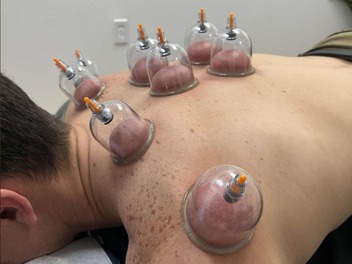
Cupping applies negative pressure, suction, that lifts the superficial layers of skin, subcutaneous fat, and superficial fascia away from the deeper fascial and muscular layers beneath. This decompression creates a vertical separation between tissue planes that have become bound together through injury, chronic load, or repetitive motion. The separation mechanically disrupts the adhesion. Simultaneously, the negative pressure draws increased blood flow into an area that was previously ischemic. Tissue that had poor circulation, which is a direct contributor to why fascial adhesions don't heal on their own, suddenly gets a major influx of oxygenated blood and repair resources.
What Happens in the Tissue
Negative pressure causes hyperemia, increased blood volume, in the local tissue. Histamine and prostaglandins are released from mast cells, triggering a fresh inflammatory response in chronically non-healing tissue. Myofascial adhesions between tissue planes are mechanically disrupted. The nervous system receives novel sensory input from the mechanoreceptors and nociceptors in the lifted tissue, modulating pain signals through gate control mechanisms. The whole sequence is the biological equivalent of rebooting a stuck system.
What Cupping Addresses at Full Swing, and Why
Paraspinal Fascial Restriction, Back Pain
The thoracolumbar fascia runs from the sacrum to the thoracic spine and wraps around the paraspinal musculature. It's one of the densest fascial structures in the body, and it is under near-constant load in anyone who lifts, sits for long hours, or carries asymmetrical loads, which describes most of Jacksonville's working population. When the thoracolumbar fascia becomes restricted, spinal rotation and lateral flexion are limited, paraspinal muscles can't lengthen properly, and chiropractic adjustments struggle to hold because the fascial sleeve is keeping the segments compressed. Cupping along the paraspinal lines decompresses this fascial envelope and restores the glide that lets adjustments stick.
Lateral Fascial Chain, IT Band, TFL, and Glute Medius
The lateral line of the body runs from the peroneal muscles of the lower leg, through the IT band, over the tensor fasciae latae, and up into the lateral hip and glute complex. Runners, cyclists, and anyone with chronic hip or knee pain usually has restriction somewhere along this chain. The IT band is not a muscle, it's a thick band of dense connective tissue that cannot be stretched in any meaningful way. Compression techniques like foam rolling can reduce the sensitivity of the structures around it but can't separate the fascial layers within the lateral compartment. Decompressive cupping along the IT band and TFL separates the fascia lata from the underlying vastus lateralis, restoring the interfascial glide that lateral knee and hip pain depends on.
Upper Trapezius and Cervical Paraspinals, Neck Pain and Headaches
Desk posture, screen time, and stress all load the upper trapezius and cervical paraspinals in the same way: sustained isometric contraction in a shortened position. Over time, the fascia surrounding these muscles becomes adherent to adjacent structures. The result is the chronic upper back and neck tightness that people describe as feeling like a concrete slab across the shoulders. Cupping along the cervical and upper thoracic region decompresses these fascial layers, increases local circulation, and reduces the tone in the muscle through neurological inhibition. Patients who have been getting chiropractic adjustments for cervical pain and not holding as long as expected often respond dramatically once the fascial component is addressed.
Plantar Fascia and Calf Complex, Plantar Fasciitis
The plantar fascia connects to the Achilles tendon system through the posterior fascial chain of the lower leg. Chronic plantar fasciitis almost always involves restriction not just in the plantar fascia itself but in the gastrocnemius, soleus, and Achilles tendon above it. Cupping along the calf and Achilles decompresses the posterior compartment, improves circulation to the Achilles, and reduces the chronic tension the tight calf complex transmits into the plantar fascia with every step. For Florida patients walking on tile and concrete year-round, this is a constant demand on the posterior chain that never gets a break the way it might in a colder climate where activity slows seasonally.
Post-Surgical and Post-Injury Scar Tissue
Scar tissue forms in three-dimensional cross-linked collagen patterns that bind to adjacent tissue planes and restrict movement along predictable fascial lines. After a knee surgery, a hip replacement, or a serious soft tissue tear, the scar tissue that heals along the incision and in the surrounding tissue can restrict movement for years after the original healing is complete. Cupping applied to the scar plane, once healing is far enough along, uses decompressive force to separate the cross-linked collagen from the adjacent tissue layers and restore the sliding motion that the scar has been blocking.
Your Cupping Session at Full Swing Healthcare
Cups are placed on target areas and held stationary or moved along fascial lines depending on the treatment goal. Stationary cupping stays on one site for two to five minutes to produce deep decompression of the local tissue. Moving cupping slides the cup along a myofascial chain, maintaining continuous decompression across a longer tissue segment. Both are used at Full Swing depending on whether the goal is focal adhesion release or chain-level fascial decompression.
The circular marks cupping leaves are not bruises. A bruise is caused by blunt trauma rupturing capillaries and leaking blood into tissue. Cupping marks are caused by increased blood volume drawn into a previously ischemic area, the tissue was blood-poor and the negative pressure brought circulation back to it. The marks reflect how restricted and poorly-perfused the tissue was before treatment. They typically fade within three to seven days. We explain this to every patient before we start so nothing is a surprise.
Cupping at Full Swing is always integrated into a broader treatment plan. It's combined with chiropractic adjustments, IASTM scraping, and where indicated, Shockwave Therapy. Dr. Muren and Dr. Hall determine which combination is appropriate at your visit based on the condition and the stage of healing. Call (904) 539-3352 or book online. Same-day appointments are frequently available.
Cupping FAQ: What Patients Actually Ask
I have an event in a few days. Will the marks show?
Cupping marks typically fade within three to seven days, and the more restricted the tissue, the darker the mark. If you have something coming up where visible marks would be a problem, let us know and we can time the treatment accordingly, or choose areas that will be covered.
Does cupping hurt?
The suction sensation ranges from mild pulling pressure to intense depending on the tissue and the cup placement. Most patients describe stationary cupping on heavily restricted areas as uncomfortable but not sharp. Moving cupping is generally less intense. The area may be tender for 24 to 48 hours after, similar to the soreness after a deep tissue massage.
Can cupping help after surgery once I’ve healed?
Yes. Post-surgical scar tissue forms in cross-linked patterns that bind to adjacent tissue planes and restrict movement for years after healing. Once the incision is fully closed and the surgeon has cleared manual therapy, typically around six weeks post-operatively, cupping applied along the scar plane uses decompressive force to separate the cross-linked collagen from surrounding tissue and restore the sliding motion the scar has been blocking.
How is myofascial cupping different from traditional cupping?
Traditional cupping in Chinese medicine applies stationary cups along meridian lines for systemic effects. Myofascial cupping at Full Swing is applied based on the specific fascial restriction identified through clinical assessment, either stationary for focal adhesion release or moving along a myofascial chain. The target is the exact tissue structure causing the problem, not a meridian pathway. The mechanism and the clinical goal are different.
How many sessions before I notice a difference?
Most patients notice a meaningful change in range of motion and tissue tension within the first two to three sessions. Chronic restrictions that have been present for months take longer to fully resolve than recent ones. Cupping at Full Swing is part of a broader treatment plan, so the change you feel is usually the combined result of the cupping, the chiropractic work, and any other soft tissue treatment in the same session.
Ready to Come In?
Same-day appointments available. 13770 Beach Blvd #4, Jacksonville, FL 32224.