Myofascial Scraping in Jacksonville, FL
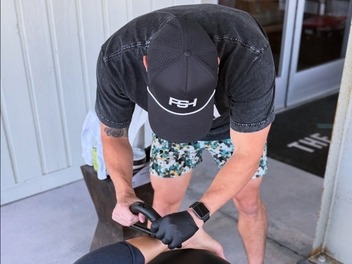
Instrument-Assisted Soft Tissue Mobilization detects and breaks up fascial adhesions that stretching, foam rolling, and conventional massage cannot reach. Dr. Muren and Dr. Hall use it as part of integrated treatment plans on Beach Blvd.
The Patient Who Stretched Every Day for Two Years and Still Couldn’t Move Right
One of the most common stories at Full Swing goes like this: a patient comes in with chronic hamstring tightness, or persistent shoulder restriction, or a heel that never fully healed after a plantar fasciitis bout three years ago. They've been stretching diligently. They've tried massage. They've done the foam roller routine. Nothing lasts more than a day or two. They assume they just have tight muscles.
They usually don't. What they have is a fascial adhesion, a region where the fascia that wraps individual muscles has become bound to adjacent tissue layers through scar tissue, chronic microtrauma, or fibrosis from an old injury. The adhesion restricts the normal sliding motion between tissue planes. Stretching a muscle that's tethered to adjacent fascia by scar tissue doesn't release the tether. You're lengthening everything around the restriction and leaving the restriction itself untouched. That's why it comes back. IASTM reaches the adhesion directly.
How the Instrument Changes What's Possible
The stainless steel instrument transmits vibration through the skin and subcutaneous tissue in a way bare hands cannot replicate. When the instrument passes over a restriction, the vibration changes character, practitioners describe it as a grinding or gritty sensation under the tool. This allows Dr. Muren and Dr. Hall to locate adhesions precisely through palpation. Once located, the instrument applies a controlled, sustained stroke that creates microtrauma in the restricted tissue, stimulates fibroblast activity, and triggers the formation of organized collagen to replace the disorganized scar tissue. The tissue rebuilds correctly.
What Myofascial Scraping Addresses, and the Clinical Reasoning Behind Each
Plantar Fasciitis and Achilles Tendinopathy
Chronic plantar fasciitis involves degenerated, disorganized collagen in the fascial insertion at the medial calcaneal tubercle, the origin of the plantar fascia on the heel bone. Stretching and orthotics manage load but don't change the collagen quality. IASTM scraping along the plantar fascia, the Achilles tendon, and the gastrocnemius-soleus complex mechanically disrupts the degenerated tissue and stimulates fibroblast recruitment to lay down new, organized collagen. Jacksonville's year-round activity culture, hard tile surfaces, and barefoot beach walking all contribute to plantar fascia stress that doesn't get seasonal recovery. IASTM combined with Shockwave Therapy is the most consistently effective conservative method for cases that haven't responded to rest and stretching.
Rotator Cuff Tendinopathy and Shoulder Restriction
Supraspinatus tendinopathy, infraspinatus restriction, and subacromial impingement all involve some combination of tendon degeneration and fascial adhesion in the rotator cuff complex. IASTM is applied transversely across the tendon fibers of the supraspinatus and along the posterior capsule to break up adhesions that are restricting glenohumeral internal and external rotation. The posterior capsule restrictions in particular are a major driver of shoulder impingement in overhead athletes, swimmers, baseball players, and golfers, that rarely get addressed by stretching alone. Scraping the posterior capsule combined with specific shoulder strengthening changes the mechanical environment in the joint in a lasting way.
Whiplash and Cervical Fascial Restriction
After a car accident on I-295 or Beach Blvd, the cervical fascia undergoes a specific injury pattern. The rapid eccentric loading of the anterior and posterior cervical musculature during a whiplash event creates microhemorrhage and inflammation in the fascial planes that surround the sternocleidomastoid, scalenes, and posterior cervical group. As this heals, dense fascial adhesions form between muscle layers that should slide independently. The result is the chronic stiffness and rotation restriction that patients describe months after the acute pain has subsided. IASTM along the cervical fascial planes restores the interfascial glide that adjustments alone cannot produce, which is why whiplash patients at Full Swing who receive both adjustment and IASTM hold their corrections longer than those who receive adjustment alone.
IT Band Syndrome and Lateral Knee Pain
The IT band is a thick band of dense connective tissue running from the TFL at the hip to Gerdy's tubercle on the lateral tibia. It is not a muscle and it cannot be stretched. The pain in IT band syndrome comes from compression of the highly innervated fat pad between the IT band and the lateral femoral condyle, not from the IT band being too tight in the conventional sense. IASTM applied transversely across the IT band and along the lateral fascial compartment breaks up the adhesions between the IT band and the underlying vastus lateralis, restoring the sliding motion that reduces the compressive forces on the lateral fat pad. Runners building mileage through Jacksonville's flat terrain consistently load the lateral line asymmetrically, and IT band syndrome is a predictable consequence of accelerated mileage increases.
Post-Surgical Scar Tissue Rehabilitation
Scar tissue after any orthopedic surgery, knee arthroscopy, ACL reconstruction, hip labral repair, spinal surgery, forms in cross-linked collagen patterns that bind to adjacent tissue planes and restrict the range of motion the surgery was meant to preserve or restore. Introduced at the appropriate healing phase, typically six weeks post-operatively or once the incision has fully closed and the surgeon has cleared manual therapy, IASTM systematically breaks up scar tissue along the surgical plane and in the adjacent tissue that was disturbed during the procedure. Patients in post-surgical rehab at Full Swing who receive IASTM as part of their rehabilitation consistently recover range of motion faster than those relying on exercise alone.
Carpal Tunnel Syndrome and Forearm Flexor Tightness
Carpal tunnel syndrome involves compression of the median nerve at the carpal tunnel from a combination of local inflammation and fascial restriction in the flexor retinaculum. IASTM along the forearm flexor compartment, the flexor digitorum superficialis, flexor carpi radialis, and pronator teres, addresses the fascial tightness that transmits compressive force into the carpal tunnel with every grip and keyboard stroke. For Jacksonville's office workers, dental professionals, and anyone doing repetitive fine motor work, this is a practical alternative to wrist bracing that doesn't address the upstream mechanical problem.
IASTM as Part of a Complete Treatment Plan
IASTM scraping is used at Full Swing as one layer of a multi-modal treatment plan. The sequence matters. For most patients, Dr. Muren or Dr. Hall uses cupping or massage first to increase circulation and loosen the superficial layers, then applies IASTM to reach the deeper adhesions, and follows with the chiropractic adjustment while the surrounding tissue is in its most receptive state. For chronic tendon conditions, Shockwave Therapy is often added to stimulate the biological healing response in degenerated tissue that IASTM alone can't fully address.
The treated area will be red and may be mildly sore for 24 to 48 hours after an IASTM session. The redness, petechiae, is a normal response to the microtrauma the technique intentionally creates. Most patients report a meaningful improvement in range of motion and a reduction in chronic tightness within two or three sessions, which makes the temporary soreness a reasonable trade. If you have a chronic restriction that massage and stretching haven't fixed, this is usually the missing piece. Call (904) 539-3352 or book online.
IASTM vs. What You’ve Already Tried
IASTM vs. Foam Rolling
Foam rolling compresses tissue from the outside. It can temporarily reduce the pain sensitivity of the muscles and fascia being rolled, and it increases local circulation during the session. What it cannot do is reach the deeper fascial layers where most adhesions form, and it cannot apply the precise, localized microtrauma that triggers fibroblast recruitment and organized collagen remodeling. Rolling feels like it’s doing something because compression-based pressure changes nerve sensitivity. The adhesion is still there when you stand up.
IASTM vs. Massage
Hands-on massage is an excellent tool for releasing muscle guarding, improving circulation, and reducing trigger point sensitivity. Its limitation is instrument feedback: bare hands can find gross tissue restrictions, but they can’t transmit the vibration that allows a trained clinician to locate the precise boundary of a fascial adhesion. The stainless steel instrument changes the sensory information available to the practitioner. That grinding or gritty sensation under the tool is the adhesion itself, detected through the vibration change. It allows Dr. Muren and Dr. Hall to work at a level of precision that manual work alone doesn’t reach.
IASTM vs. Stretching
Stretching lengthens contractile muscle tissue. A fascial adhesion is not contractile. It is a structural binding between tissue planes made of disorganized collagen. Pulling on a muscle that is tethered by an adhesion simply lengthens everything around the restriction. The restriction itself doesn’t move. The range of motion improvement from stretching a restricted area is real but temporary, because the adhesion reasserts as soon as the stretch is released. IASTM applies mechanical force directly to the adhesion and disrupts it structurally. The improvement from that disruption persists because the structure has changed.
IASTM vs. Cortisone Injection
Cortisone is an anti-inflammatory. It reduces pain and swelling at the injection site, which can be genuinely useful for acute flares and for creating a window of reduced pain in which rehabilitation can begin. What it does not do is address the fascial adhesion or the disorganized collagen in a chronic tendon. Multiple cortisone injections for the same chronic tendon condition can actually weaken the tendon structure over time. IASTM works on the tissue quality, not the inflammation. For chronic tendinous conditions that have already gone through multiple cortisone cycles, IASTM combined with Shockwave Therapy is usually the more appropriate next step.
Ready to Come In?
Same-day appointments available. 13770 Beach Blvd #4, Jacksonville, FL 32224.