Shockwave Therapy in Jacksonville, FL
Six months after a soft tissue injury, your body makes a quiet decision: it stops trying to fix it. The damaged tissue gets reclassified as a permanent background condition, and the fibroblasts, collagen production, and blood vessel growth that were driving the repair just stop. Shockwave Therapy reverses that decision with focused acoustic waves that restart the healing cascade at the cellular level.
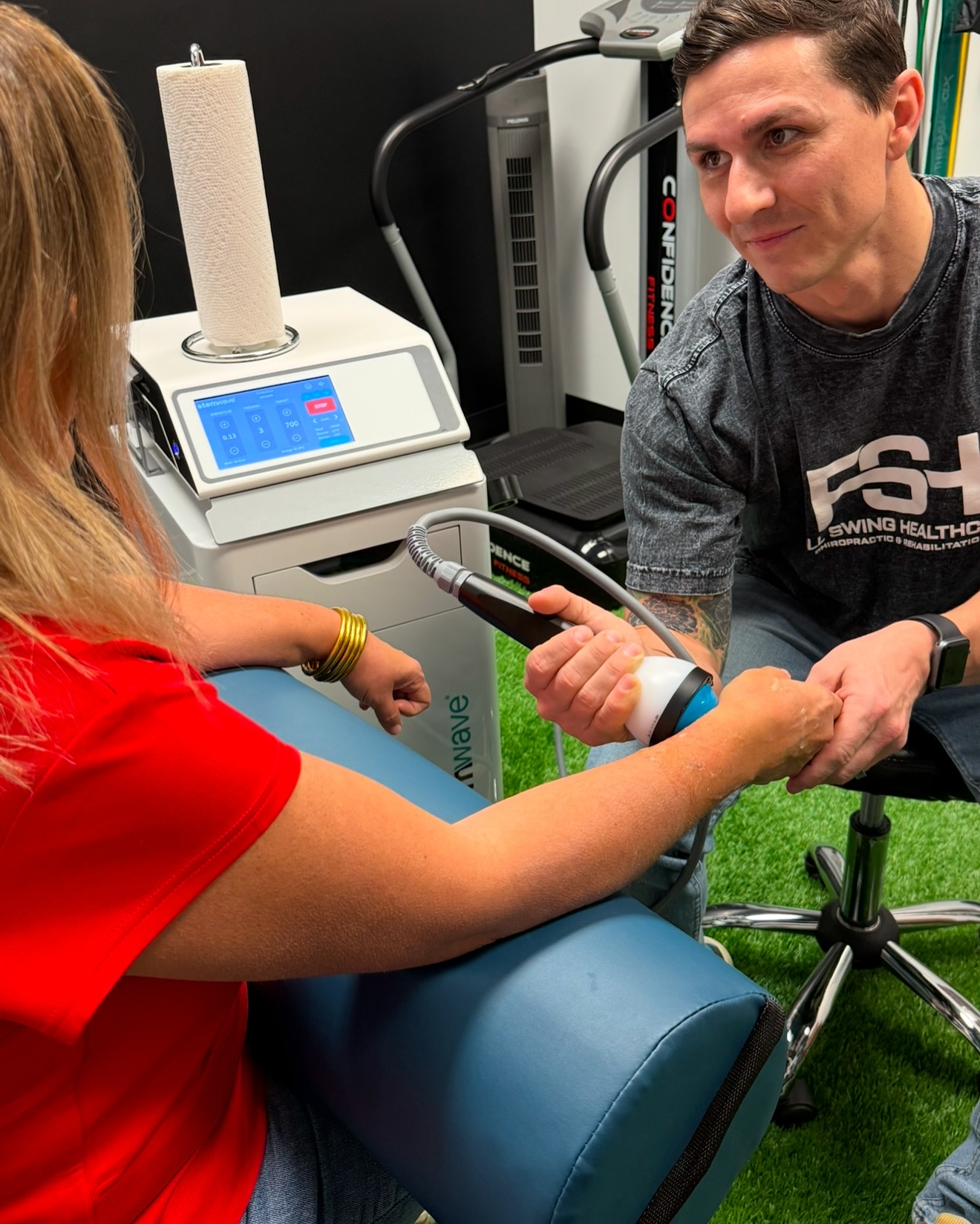
Shockwave Therapy at Full Swing Healthcare
Dr. Muren uses the StemWave acoustic shockwave device to deliver focused high-energy pressure pulses directly into damaged soft tissue. The treatment is non-invasive, requires no downtime, and is performed in the same visit as chiropractic and soft tissue work. Most patients complete 4–8 sessions spaced one week apart.
We Kept Seeing the Same Patient.
They'd been in pain for six months. They'd done the physical therapy. They'd gotten the cortisone injection, maybe two. They'd rested, iced, stretched, and foam rolled. Their plantar fascia or their Achilles or their rotator cuff still hurt every single morning. Their doctor told them to keep waiting or consider surgery.
That pattern is what made Dr. Muren invest in Shockwave Therapy. Not because it's trendy, but because it solves a specific biological problem that no amount of waiting resolves on its own: chronic soft tissue injuries stop healing. The body stops sending repair resources to tissue it has decided is just part of the background now. The injury is no longer "acute" in the body's accounting, so it gets no fibroblasts, no new collagen, no blood vessel growth. It just stays broken.
Focused acoustic waves change that equation. The device sends high-energy pressure pulses directly into the damaged tissue. At the cellular level, this mechanical stimulus triggers a healing cascade: new capillary formation, fibroblast recruitment, stem cell activation, and breakdown of the disorganized calcified tissue that builds up in chronically injured tendons and fascia. The body gets a signal it hasn't received in months: this tissue needs to be repaired. And it responds.
What Actually Happens in a Shockwave Therapy Session
Dr. Muren starts with an assessment. Shockwave is powerful and it matters that it's aimed correctly. He identifies the exact tissue involved, the degree of degeneration, and whether any underlying mechanical dysfunction is feeding the problem. A plantar fasciitis case might involve tight gastrocnemius-soleus mechanics pulling on the fascia. An Achilles tendinopathy might have a pronation pattern driving the load. Shockwave Therapy treats the injury; the chiropractic and soft tissue work addresses what caused it. Both happen in the same visit.
The treatment itself takes about 10 minutes per site. The applicator head is moved over the target tissue in a systematic pattern. You'll feel a deep, rhythmic thumping sensation, uncomfortable but not sharp. Most patients rate it around a 4 or 5 out of 10. The day after treatment, the area often feels sore and more inflamed. That's not a bad sign. That's the inflammatory cascade the treatment intentionally triggered. It settles within 24–48 hours, and patients typically begin feeling measurable improvement after the second or third session.
Most protocols run 4–8 sessions spaced 5–7 days apart. Dr. Muren reassesses after session 3. If the tissue isn't responding, the diagnosis or approach changes. We don't run patients through eight sessions on a hunch. The response to treatment is itself diagnostic information.
What Shockwave Therapy Treats Well
Plantar Fasciitis
This is the most common condition we use shockwave for. The chronic, thickened, degenerated fascia at the heel and arch that doesn't respond to stretching, night splints, or cortisone responds dramatically to acoustic wave therapy. The research on shockwave for plantar fasciitis is among the strongest in the soft tissue literature. Multiple randomized controlled trials show outcomes comparable to surgery at 12-month follow-up, without the recovery time or risk. Jacksonville's year-round activity on tile, concrete, and sand means the posterior chain never gets a genuine seasonal rest, and plantar fasciitis here tends to be more persistent than in climates where people stop running in the cold months.
Achilles Tendinopathy
Both insertional and mid-substance Achilles tendinopathy respond well to shockwave. The Achilles midpoint is relatively avascular, which is why it degenerates and fails to heal independently. Shockwave drives angiogenesis directly into that poorly-perfused zone. For athletes who've been managing Achilles pain for a season or more and aren't getting better with eccentric loading protocols alone, shockwave is usually the intervention that tips the balance. Eccentric loading builds strength around the problem. Shockwave fixes the tissue itself.
Calcific Shoulder Tendinitis
Calcium deposits form in rotator cuff tendons, particularly the supraspinatus, as a response to chronic micro-damage and poor tissue perfusion. The deposits create pain with overhead movement and resist cortisone injection. Shockwave mechanically disrupts the calcified deposit through cavitation forces at the wave front, causing fragmentation that the body can then reabsorb. Studies consistently show significant calcium reduction and pain relief at six and twelve months post-treatment. This is one of the few conservative options that actually changes the tissue rather than just managing symptoms.
Patellar Tendinopathy (Jumper's Knee)
The patellar tendon is under enormous load in athletes who jump, decelerate, or train on hard surfaces. Degeneration at the inferior pole of the patella creates the chronic anterior knee pain that players manage through every season. Shockwave combined with appropriate load management and patellar tendon rehabilitation protocol consistently produces better outcomes than rest alone, and it does it without taking the athlete out of training entirely while the tissue heals.
Tennis Elbow and Golfer's Elbow (Lateral and Medial Epicondylitis)
Lateral epicondylitis involves degenerated extensor carpi radialis brevis insertion on the lateral epicondyle. Medial epicondylitis involves the flexor-pronator mass on the medial side. Both are overuse tendinopathies with the same core problem: disorganized, degenerative collagen that hasn't remodeled. Shockwave stimulates fibroblast activity and new collagen formation at exactly the insertion point where the degeneration is concentrated. For Jacksonville's golfers at TPC Sawgrass and Ponte Vedra who have been playing through elbow pain for months, this is often the first treatment that produces lasting change.
Hamstring Tendinopathy at the Ischial Tuberosity
Proximal hamstring tendinopathy produces deep buttock pain with sitting and sprinting that is frequently misdiagnosed as sciatica or SI joint dysfunction. The hamstring insertion on the ischial tuberosity is under heavy compressive and tensile load in runners and cyclists. When the tendon degenerates at this insertion, the chronic ache with sitting and the sharp pain at the start of a sprint are often present for years before the diagnosis is made correctly. Shockwave applied to the ischial tuberosity insertion, combined with progressive hamstring loading, is the standard of care in sports medicine for this condition.
Shockwave Therapy FAQ: Jacksonville, FL
Does shockwave therapy hurt?
The treatment is intense but tolerable. Most patients describe it as a deep rhythmic thumping, around a 4 or 5 out of 10. Post-treatment soreness for 24–48 hours is normal and expected. It’s the inflammatory response the therapy intentionally triggers, and it settles before the next session.
How many sessions will I need?
Most cases require 4–8 sessions spaced about a week apart. Dr. Muren reassesses after session 3. If you’re responding, we continue. If not, we revisit the diagnosis. We don’t run open-ended protocols.
Does insurance cover Shockwave Therapy?
Most plans don’t cover shockwave therapy yet, though coverage is expanding. We can check your benefits and give you exact pricing upfront. See our insurance page for details, or read our full breakdown of shockwave therapy costs in Jacksonville.
Can I get shockwave in the same visit as my chiropractic adjustment?
Yes, and this is usually the preferred approach. Dr. Muren performs the shockwave application on the injured tissue and addresses the mechanical dysfunction feeding it through chiropractic and soft tissue work in the same session. Treating the injury without addressing what caused it is only half the solution.
How is shockwave different from therapeutic ultrasound?
Therapeutic ultrasound uses continuous low-energy waves to generate gentle heat in superficial tissue. Shockwave delivers focused high-energy pressure pulses at a much higher intensity, causing mechanical disruption of degenerated tissue, cavitation forces that break up calcific deposits, and a cellular stress response that triggers real biological repair. They operate on completely different mechanisms and at completely different energy levels. Therapeutic ultrasound is a warming tool. Shockwave is a tissue-remodeling tool.
Ready to Come In?
Same-day appointments available. 13770 Beach Blvd #4, Jacksonville, FL 32224.